The Crocus as Herald: Crafting a Spring Flower Wreath Dotted with Cheerful Colors
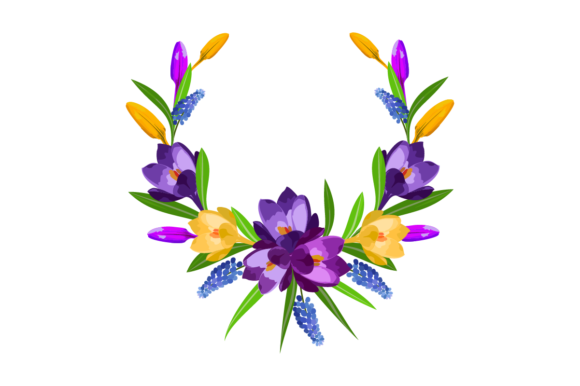
As winter’s monochrome palette begins to retreat, one of the first and most poignant signals of the seasonal shift is the emergence of the crocus. These resilient, cup-shaped blossoms push through the last frosts, bringing flashes of purple, white, yellow, and gold to dormant gardens. When captured in a wreath, this early promise becomes a tangible, celebratory object. A Spring Crocus Floral Wreath is not merely decoration; it is a symbolic piece, a wearable or displayable proclamation of renewal. This article explores the creation, significance, and versatile application of spring flower wreaths, particularly those dotted with the cheerful colors of crocuses and their floral companions.
From Garden Ground to Wreath Form: Characteristics of Crocus Wreaths
The crocus presents unique characteristics that influence wreath design. Unlike larger, more robust blooms, crocuses are delicate and relatively small. This necessitates thoughtful composition. A wreath featuring these flowers often employs them as highlights or focal clusters amidst other spring greenery like moss, ivy, or early budding branches. The phrase dotted with cheerful colors accurately describes the typical aesthetic: points of vibrant hue distributed across a neutral or green base. This creates a balanced visual that is lively without being overwhelming.
Material choice is paramount. Fresh crocus blooms are ephemeral, so many artisans opt for preserved, dried, or high-quality silk replicas to ensure longevity. The color palette is intrinsically joyful—purples speak of royalty and mystery, yellows evoke sunlight and optimism, whites offer purity and simplicity. Combining these within a single Spring Crocus Floral Wreath captures the diverse personality of spring itself: a time of varied and unpredictable beauty.
Core Advantages of a Spring Flower Wreath
Why choose a wreath, and specifically a spring-themed one, as an object of focus? The advantages are both practical and symbolic.
- Seasonal Connection: It physically manifests a transient season, allowing one to hold and display its essence.
- Versatility of Placement: Unlike vertical arrangements, a wreath’s circular form is ideal for doors, tabletops, walls, or even as a centerpiece surrounding a candle.
- Artistic Accessibility: Creating a spring flower wreath dotted with cheerful colors can be a simple or advanced project, suitable for hobbyists and professional florists alike.
- Emotional Resonance: It serves as a gift of optimism, a decoration for celebrations like Easter or spring weddings, or a personal reminder of growth and new beginnings.
Real-World Applications: Who Uses These Wreaths and How?
The audience for a Spring Crocus Floral Wreath is remarkably broad, reflecting the universal appeal of spring.
Home Decorators and Seasonal Enthusiasts
For individuals seeking to sync their living spaces with the natural world, a spring wreath is a quick and effective update. It replaces winter’s evergreen or barren wreaths with a burst of color. Placed on a front door, it communicates welcome and vibrancy to the entire neighborhood. Using a crocus-centric design offers a more subtle, botanical-specific statement compared to generic floral mixes.
Event Planners and Celebratory Hosts
Spring events, from garden parties to bridal showers, often incorporate floral motifs. A wreath can function as a thematic anchor. For a wedding, smaller spring flower wreaths dotted with cheerful colors might adorn chair backs or serve as crowns for flower girls. The crocus, symbolizing youthful gladness, is particularly apt for such occasions.
Educators and Workshop Leaders
In botanical or art education, the process of constructing a wreath provides hands-on learning about plant identification, color theory, and design principles. Focusing on a specific species like the crocus adds a layer of botanical study. Workshops can teach participants how to preserve flowers, arrange balanced compositions, and understand seasonal flora.
Artisans and Small Business Owners
For creators in the floral or craft industries, offering seasonal products like a Spring Crocus Floral Wreath aligns inventory with consumer demand. It represents a niche product that can attract customers looking for something specific and symbolic. The “cheerful colors” are a strong marketing point, evoking the emotional benefits of the purchase.
Design Considerations and Implementation
Crafting an effective wreath requires more than just attaching flowers to a ring. Several considerations ensure the final piece is both beautiful and durable.
Structural Foundations
The base is critical. Grapevine wreaths offer a rustic, natural look perfect for spring’s organic feel. Straw or foam bases provide a fuller, more uniform shape for dense arrangements. The choice influences whether the crocuses will appear as sporadic jewels on a textured vine or as part of a lush, continuous band of color.
Color Distribution and Rhythm
The concept of dotted with cheerful colors should be interpreted with artistic rhythm. Clusters of two or three crocuses can be spaced at irregular intervals around the wreath, interspersed with filler like baby’s breath, fern, or small daffodils. This avoids a monotonous pattern and encourages the eye to travel around the circle, discovering new color points.
Longevity and Material Choices
If using fresh crocuses, the wreath will be a temporary piece, perhaps for a single event. For longer-lasting decoration, dried crocuses retain much of their color and form. Artificial crocuses made from silk or other fabrics offer complete durability and consistent color, allowing for wreaths that can be stored and reused year after year. This is a practical consideration for businesses or individuals seeking a sustainable decoration.
Contextual Harmony
A wreath should harmonize with its intended environment. A Spring Crocus Floral Wreath with dominant purple tones might pair beautifully with a door painted in soft gray or yellow. A wreath for a table centerpiece should be low-profile to allow for sightlines across the table. Considering the backdrop and practical function ensures the wreath enhances rather than overwhelms its setting.
Observations on Trends and Symbolic Depth
Beyond mere craft, the spring flower wreath holds cultural and aesthetic significance. Currently, there is a trend towards “biophilic design”—incorporating natural elements into living spaces to improve well-being. A wreath made of real or realistically rendered spring flowers directly fulfills this desire. Furthermore, the specific choice of crocus taps into a deeper botanical narrative. In many cultures, the crocus is associated with cheer after hardship, a direct parallel to spring following winter.
Professional florists observe that requests for seasonally-specific wreaths have increased, as people seek more personalized connections to the calendar. A customer asking for a Spring Crocus Floral Wreath is often looking for something more nuanced than a generic “spring mix.” They are engaging with the specific symbolism and color story of that early bloom.
The act of making or selecting such a wreath is, in itself, a mindful practice. It forces one to consider the colors, shapes, and meanings of the season’s first offerings. Whether crafted from gathered garden crocuses or curated from a florist’s selection, the final product—a circle dotted with cheerful colors—stands as a complete, self-contained representation of hope and renewal. It is an art object rooted in nature’s most reliable and joyous cycle.